

What's going on with DAVeMoS

October 13th, 2026
SAVE THE DATE: Integrating Geospatial and Image Data in Travel Behaviour Models
The 5th IATBR Webinar will be held on October 13th. This time we will focus on integrating geospatial and image data in travel behaviour. More information of the seminar can be found in here.

October 1st, 2026
Our SeeFar paper was awarded RERITE award at hEART2026 conference
Our paper SeeFar paper which was presented at hEART conference was awarded RERITE award. RERITE is a global transportation community for open science, reproducible research and replicable studies. Further information about the community can be found in here.

September 23th, 2026
Outdoor wayfinding in the age of digital technology and neurophysiology
This paper presents a systematic review of empirical outdoor wayfinding studies published between 2010 and 2025, including studies conducted in simulated outdoor environments such as virtual reality (VR). The review examines how wayfinding has been conceptualised and measured across different theoretical and methodological traditions. Results show increasing use of VR, eye-tracking, electroencephalography (EEG), and other neurophysiological approaches alongside traditional behavioural, survey, and knowledge-assessment methods. The paper can be found in here.

September 14-15, 2026
DAVeMoS at NECTAR cluster 4 and 6 workshop
DAVeMoS participated at NECTAR cluster 4 and 6 which took place in Porto, Portugal. In this workshop, Georgia presented our recent research on what factors keep people car dependent, by looking on differences and similarities in different local contexts.

September 1, 2026
Welcome to Lorenzo Maccarone
Welcome to Lorenzo Maccarone from the University of Bologna, who will be staying with us for six months to conduct research on the role of micromobility during public transport disruptions.

July 16-17, 2026
FWF-DFG SeeFar workshop
On 16-17 July, at TU Munich, we will organise international workshop which focuses on electrification and automation of road freight transport. This event is part of SeeFar project which is jointly funded by DFG and FWF. The programme of the workshop can be found in here.

July 2, 2026
Mobilities in transitions: perspectives on travel behaviour from Central and Eastern Europe
A special collection on travel behaviour in Central and Eastern Europe is completed. This issue was edited together with Milos Mladenovic (Aalto University) and Stefanie Peer (WU), and was part of IATBR 2024 special issue. The collection can be found in here.

June 17, 2026
The 4th IATBR Webinar
On behalf of the International Association for Travel Behaviour Research (IATBR), Mark Zuidgeest and Prateek Bansal co-organized the 4th webinar, which focuses on the role of emerging neurophysiological data and immersive experiments in travel behaviour modeling.
The Speakers are:
Thomas Hancock & Jamal Amani Rad (University of Leeds),
Bilal Farooq (Toronto Metropolitan University),
Bastian Henriquez Jara (Universidad de Chile)

April 24, 2026
Lange Nach der Forschung 2026
Like in previous years, we are participating again this year in the 2026 Lange Nacht der Forschung (Long Night of Research), Austria’s largest event on science, research, and innovation, aimed at all age groups. This year, we are presenting our VR lab capabilities.

April 14 - April 16, 2026
MSCA TRANSFORM Doctoral Network Spring School
From 14-16, we hosted a MSCA TRANSFORM doctoral network's spring school. All 30 PhD students and supervisors of TRANSFORM doctoral network gathered at institute to learn, train and research together in exploring different aspects of Behaviour Theories, Mobility Culture, Transformative Policy, System Thinking and many other research related skills. During this week, we also visit our non-academic partners and Aspern Mobility Lab and SeeStadt development as case study area in Vienna.

March 25, 2026
Activity and time-use diary for a neighborhood
telecommuting centre living lab in Stockholm,
Sweden
This paper adopts a longitudinal, mixed-methods living-lab approach to examine factors influencing Neighbourhood Telecommuting Centre (NTC) use compared to employer offices and home offices. Data from a real-life NTC living lab in Stockholm, Sweden, were analyzed using a three-week time-use diary. Qualitative interviews were used to contextualize inconsistencies between participants' expectations and actual usage. Findings indicate that NTCs can reduce commuting times and provide a professional environment closer to home; however, adoption is constrained by organizational norms, logistical barriers and continued reliance on private cars for trip-chaining. The paper can be found in here.

March 11-13, 2026
UNLOCK15 consortium meeting in Vienna
We proud to host the UNLOCK15 consortium meeting here in Vienna. For 3 days, our city became a "shared laboratory" where researchers, practitioners, and stakeholders from across Europe gathered to bridge the gap between theory and practice. Millions thanks to Mobyome colleagues who have been spearheading the exchange events.

February 5, 2026
The Relationship between E-Shopping and Goods Delivery via Transport SuperApps and Daily Time Use
This study explores how e-shopping and good delivery services shaped individual time allocation across various activities and locations. The study employs a one-week time-use and app-use diary from four Indonesian cities. The paper can be found in here.

January 16, 2026
Understanding the physiological stress of e-scooter riders in a shared bike lane
This research investigates the physiological stress of e-scooter riders using virtual reality to simulate dynamic traffic conditions on a shared bike lane in Vienna. It provides insights into factors shaping e-scooter riders’ physiological responses provide evidence for analyzing accidents and risky behaviors from a psychophysiological perspective and may guide the development of interventions to enhance e-scooter comfort, safety and integration in shared road. The paper can be found in here.

October 10th, 2026
Changes in Travel Time Ratios (TTR) Before and During the First COVID-19 Lockdown in Austria
This paper analyse how long individuals travel to reach different activity destinations and how much time they ultimately spend there, and how this balance varies across trip purposes, journey structures, and socio-demographic groups before and during the COVID-19 lockdown. Overall, the findings suggest that the pandemic reshaped not only the volume of mobility but also the temporal balance between access and participation across population groups. The paper can be found in here.
October 1st, 2026
Spatiotemporal associations between e-shopping in Transport-SuperApps and daily time use across urban contexts
This study investigates how e-shopping, delivered through Transport-SuperApps (app-based platforms that integrate ride-hailing, e-shopping, and other on-demand services), is associated with a reorganisation of daily time use across spatial and temporal dimensions and diverse urban contexts. The findings reveal patterns consistent with both substitution and rebound effects. E-shopping usage is associated with lower engagement in out-of-home activities, particularly physical shopping. The paper can be found in here.

September 20-22, 2026
SAVE THE DATE: Integrating Geospatial and Image Data in Travel Behaviour Models
DAVeMoS students participated at Universitätstagung Verkehrswesen 2026 in Meißen. Further information of the gathering can be found in here.

September 9, 2026
DAVeMoS at FreighTSim 2026
DAVeMoS delivered a presentation at FreighTSim workshop which was jointly organised by TU Berlin and DLR. Denissa presented our recent outputs in generating drivers' activity schedule for an ABM freight simulation.

August 1, 2026
Prof. Susilo as Professor in Transport Systems Integration at TU Delft
From August 1st 2026, Prof. Susilo will spend 80% of his time as a Full Professor in Transport Systems Integration at TU Delft, whilst continue to work at BOKU for 20% of his time.

July 13-15, 2026
We are at NECTAR 2026
We will be at NECTAR 2026 conference in Munich, Germany. As an institute we will present 4 (four) of our works in this conference, range from capturing wayfinding behaviour via biometric mechanism to 15-minutes city and young traveller behaviour analyses. The programme can be seen in here.

July 1, 2026
The closing of the semester
With the end of the semester, time to thank everybody and celebrate all the achievements that we have achieved so far this year. Many thanks to everyone for all of your hard work!
June 16, 2026
Consumer-product attachment framework on electric motorcycle conversion adoption
This paper investigates how psychological attachment to existing motorcycles shapes the adoption of electric motorcycle conversion (EMC) — a resource-efficient and cost-effective pathway toward decarbonising transport in Indonesia. Using a choice experiment with 929 motorcyclists in Bali and an Integrated Choice and Hierarchical Latent Variables model, we unpack how emotional bonds with existing vehicles shape the decision to convert to electric. The paper can be found in here.

April 23, 2026
DAVeMoS presented in FFG website's as a success story
It is an honour that our BMIMI endowed professorship program, DAVeMoS, has been featured in the FFG Austrian Research Promotion Agency’s news feed and success stories page (https://www.ffg.at/success-stories/davemos-neue-wege-fuer-die-mobilitaet-von-morgen). None of this would have been possible without the contribution of each member of the group.

April 13, 2026
Changes in the Service Evaluations of Automated
Buses Over Time
Using a one-year, three-wave panel surveys, conducted in Stockholm, Sweden, this work evaluates the passengers’ real-world experiences in relation to an automated bus operating in mixed traffic on public roads. Latent curve analysis was applied to the longitudinal data to examine the evolution of service evaluations. Further information of the work can be found in here.

March 18, 2026
Monitoringbericht Automatisierte Mobilität 2025
Another year where DAVeMoS have privilege to contribute to the Annual Monitoring Report of Automated Mobility in Austria. The report can be found in here.

March 5-6, 2026
DREAMS consortium meeting in Budapest
Another milestones of DUT DREAMS project: We continue to deploy and evaluate the intervention activities in our living labs. We also organised a Stakeholder Symposium in Budapest which was very well attended. The event involves joint presentations and discussions with other DUT projects. Our consortium meeting was closed with a visit to and a meeting at Rakosmente, DREAMS' living lab location in Hungary.

January 29-30, 2026
Mobility and Time-Use Workshop in Dresden
Prof Susilo was invited to participate at an AgiMo workshop at TU Dresden which focuses on mobility and time-use survey. In this workshop Prof. Susilo presented his previous experience on collecting a cross-dimensional physical and virtual time and app use diaries.

January 12, 2026
New Year, New Responsibility
With the start of the new year, Prof. Susilo will start his role as the new chair of the International Association of Travel Behaviour Research (IATBR), for period 2026 and 2027. From this January, Prof. Susilo also will serve as the Associate Editor of Transportation Research part A.
October 2nd, 2026
Pre- and post-ride determinants of autonomous shuttle acceptance
The study extends theory on Automated Shuttle adoption by showing that the determinants associated with use intention differ between the pre- and post-riding phases. The findings suggest that experience may act as a structural filter on acceptance rather than merely a moderator, a proposition that warrants confirmation in longitudinal designs. The paper can be found in here.

September 28-October 1, 2026
DAVeMoS at hEART conference
Wanrong presented some recent outputs of SeeFar project at hEART conference. Further information of the conference can be found in here.

September 16-18, 2026
UNLOCK15 consortium meeting
UNLOCK15 consortium meeting successfully being held in Porto. A major highlight of the meeting was our on-site visit to the Carvalhido Learning Living Lab. Walking the streets of Carvalhido provided firsthand insight into how locally rooted narratives, civic engagement, and targeted interventions can unlock the potential of the 15-minute city model in diverse residential neighborhoods.
Thank-you to our Porto hosts and all partners for the energizing two days. Exciting milestones are ahead as we continue translating research into empowering tools for citizens and municipalities!.

September 2, 2026
Winda Halim's PhD Defense
DAVeMoS' co-supervised PhD student, Winda Halim, sucessfully defended her PhD at Bandung Institute of Technology, Indonesia. Her thesis focused on identifying and evaluate the cause of dangerous driving behaviour using biometric data and naturalistic data collections.

July 20-24, 2026
We are at ISDC 2026
We will be at the 44 International System Dynamic Conference (ISDC) 2026 in Delft, the Netherlands. As an institute we will present 4 (four) of our works in this conference. The programme can be seen in here.

July 6-10, 2026
We are at WCTRS 2026
At WCTRS 2026 conference, Toulouse, France, we presented 8 (eight) of our works, range from machine learning, object recognition and cognitive load analyses to 15-minutes city and young traveller behaviour analyses. The programme can be seen in here.

June 23, 2026
"Kultur in Wiener Flur" is BACK !
After a successful multi-week pop-up activities last summer, "Kultur im Wiener Flur" is returning — this time as a one-day event on 23 June 2026 - ALL IS WELCOME !
The event is part of DREAMS, a research project exploring how co-created, people-centred mobility services can help build more accessible and sustainable neighbourhoods on the urban fringe.
This event is organised and hosted by Cornelius Wohlgenannt (stadtland planung GmbH), Linda Dörrzapf (MOVE – Transport System Planning) and Georgia Charalampidou & Yusak Susilo (Institute for Transport Studies (IVE), BOKU University).
Further information can be found in here.

May 10, 2026
The official close of DAVeMoS project
With the acceptance of the final report by the FFG, the DAVeMoS Endowed Professor project which was started on October 2019 to September 2025, finally closed. We started our new professorship/chair during the awake of COVID19 pandemic, which was not an easy walk in the park. Within the 6 years period, we managed to publish 60 journal articles and 72 conference papers, supervised 10 master’s theses and 11 PhD theses, 4 new courses and 1 EPICUR University Alliance lecture series, received 1 teaching award and 1 PhD award, delivered 34 keynotes and guest lectures, secured more than 1.8 million euros of additional funding, and organised 10 national and international conferences, including the 17th IATBR International Conference on Travel Behavior. All of these would not be possible without every team member contribution to the project. BIG THANK YOU to ALL!

April 20, 2026
Artificial Intelligence for Climate Adaptation
Dr. Miguel Costa, from the Technical University of Denmark gave a seminar on a novel decision-support framework using reinforcement learning (RL) for longterm
flood adaptation planning. More information about the seminar can be found in here.

April 13 - April 30, 2026
Call for Experiment Participation !
We will be conducting our wayfinding experiment from 13th to 30th April. We will investigate the learning process mechanisms of individual in recognising his/her neighbourhoods. For further information, please have a look in here.
March 13, 2026
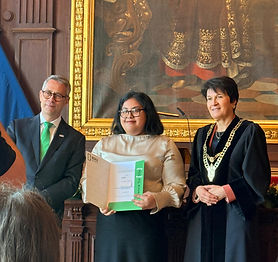
SAGE Jubileumfond project got honoured
Our City of Vienna’s Jubileumfond funded project "Spatial Aging & Green Environments for a resilient, elderly-friendly city of Vienna" was celebrated in BOKU. Denissa Purba as the PI of the project received the award. In this project, using biometric measurements we investigate the temporal formation of elderly's spatial cognition and wayfinding.

February 10-11, 2026
Institute Team Building
In this two days we spent time together, far away from our office, to get to know each other better and also to discuss different issues we have as an institute and how to anticipate incoming changes and challenges.
January 28, 2026
An exploration of the applicability of information processing theories in road hazard perception context using e-scooter simulator in augmented virtuality scenarios
This paper aims to provide a cognitive perspective on the hazard perception process in the traffic situation based on the conceptual frameworks of two complementary theories of brain information processing, namely, Signal Detection Theory and Predictive Coding Theory. The study uses an augmented virtuality scenario encompassing a simplified traffic situation, where participants are faced with hazard cues characterised by a different degree of predictability. The work can be found in here.
Forthcoming Conferences
Here you can find relevant forthcoming conferences related with digitalisation and automation


Automation in Austria
Here you can find information to relevant initiatives of digitalisation and automation in Austria
Publications
Here you can find various different types of publications that DAVeMoS team have previously published
Knowledge Pool
Here you will find a knowledge pool about system level impacts of automation and digitalisasion